
With the Serious Fraud Office (SFO) promising a warmer welcome for corporates that self-report misconduct, does its newly published External Guidance on Corporate Cooperation and Enforcement mark a turning point in corporate criminal enforcement?
Partner Richard Sallybanks, alongside associates Megan Curzon and Matt Davies, talk to Fraud Intelligence, weighing in on whether the SFO’s revised approach, underpinned by clear timelines, updated cooperation standards, and a "cast iron guarantee" of a Deferred Prosecution Agreement (DPA) will shift corporate behaviour.
The article unpacks key issues, including:
- The risks and benefits of self-reporting
- What counts as ‘full’ or ‘exemplary’ cooperation?
- The growing criminal exposure under the Economic Crime and Corporate Transparency Act 2023
Despite the SFO’s push, with only 12 DPAs concluded since 2014, Fraud Intelligence ask whether the incentives are strong enough to encourage change or whether silence may still feel like the safer option for some.
This article was first written for and published by Fraud Intelligence on 14 June 2025. To read the full article, please click here.


More like this

Seven BCL Partners Recognised in Who’s Who Legal: Investigations 2024
BCL partners, Shaul Brazil, Ian Burton, Shula de Jersey, Michael Drury, Julian Hayes, Richard Sallybanks, and Harry Travers, have been named as recommended lawyers in the field of criminal

We Need to Talk About Corporate Criminal Liability
The fines of £10m for Transport for London and £4m for Tram Operations Ltd following the Croydon tram tragedy signal a wrong turn in health and safety sentencing, and corporate criminal liability generally

BCL Partners named Thought Leaders in Who’s Who Legal: Global Elite 2024
We are delighted to announce that BCL Partners Shula de Jersey and Richard Sallybanks have been recognised as Thought Leaders in the field of Business Crime Defence in Who’s Who Legal Global Elite 2024.
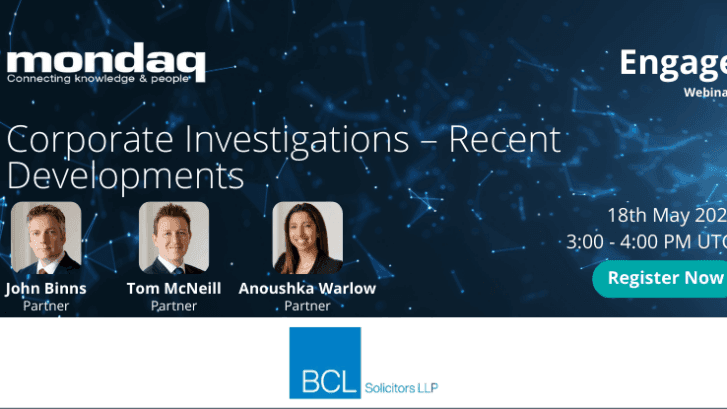
Webinar: Corporate Investigations – Recent Developments
We are pleased to be teaming up with Mondaq on the 18th May 2023 to host a live webinar discussing the recent developments in corporate investigations and regulatory compliance.
BCL’s John Binns speaks at English Law Day Conference in Istanbul 2023
BCL partner, John Binns will be joining the expert panel of speakers at the English Law Day Conference in Istanbul organised by The Eurasian CIS Legal Professionals’ Forum
BCL partners author the England & Wales chapter of ICLG: Corporate Investigations 2023
BCL partners, Michael Drury, Richard Reichman, and Tom McNeill examine some of the issues in corporate investigations laws and regulations

BCL have been ranked in the GIR 100 2024 guide
We are delighted to have been ranked once again as a leading firm for corporate criminal defence by Global Investigations Review 100 guide 2024.

Independent Review of the Criminal Courts: Comprehensive Proposals for Reform Under Scrutiny
In LexisNexis Corporate Crime's latest article, Partner John Binns and Associate Amelia Clegg explore the comprehensive proposals outlined in Part 1 of the Independent Review of the Criminal Courts, led by Sir Brian Leveson, former President of the Queen’s Bench Division.

Enforcement of Corporate Crime Laws in England & Wales
In this latest insight, BCL’s Michael Drury, Of counsel and Partner Tom McNeill examine the roles of the Serious Fraud Office (SFO), Financial Conduct Authority (FCA), Competition & Markets Authority (CMA), HMRC, Insolvency Service, and the Crown Prosecution Service (CPS).

Senior Manager Test and its Implications
BCL Partner, Tom McNeill, discusses the Crime and Policing Bill 2025, which is set to expand significantly corporate criminal liability with the proposed ‘senior manager test.’

Tom McNeill Warns of Unintended Consequences in the Crime and Policing Bill
In an article for the New Law Journal, BCL partner Tom McNeill warns that the proposed Crime and Policing Bill could significantly expand corporate criminal liability through the introduction of an expanded ‘senior manager test’.